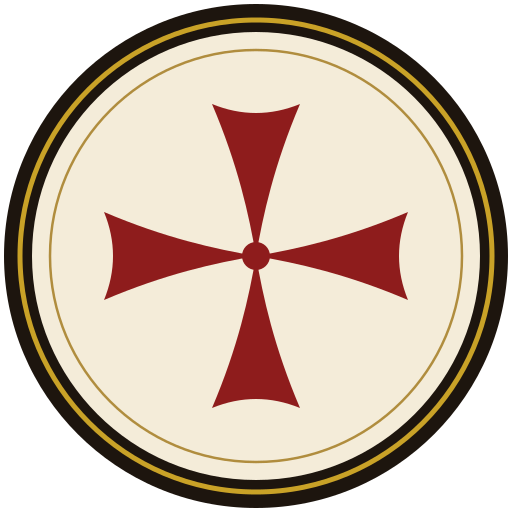
The Templar Cross and Mantle
The red cross of the Knights Templar and the white mantle worn by the brothers are two of the most famous pieces of military clothing in history. Worn on the shoulders of the Order’s knights for nearly two centuries, they have become the most recognizable symbols of the Templars and have given rise to an entire vocabulary of Templar symbolism. The cross and the mantle are at the heart of the Order’s visual identity and have inspired a vast literature of interpretation, both medieval and modern.
This cluster page tells the story of the Templar cross and mantle. It is a companion to The Meaning of Beauseant and to the article on Templar Initiation and Secret Rites.
The Mantle: White Symbol of Purity
The Templar mantle was the long, flowing cloak worn by the brothers of the Order. It was originally intended to be plain and unadorned, in keeping with the Order’s vow of poverty. The Rule of the Templars (the Regula Latina — the Latin Rule) prescribed that the mantle should be of one color, without decoration, and that it should be of sufficient length to cover the body completely.
At first, the mantle was plain brown or grey, like the simple monastic habits of the period. But in 1147, Pope Eugenius III granted the Templars the right to wear a red cross on their mantles, and the Order began to use white as the standard color of the cloak. The white mantle with the red cross was from then on the most recognizable symbol of the Order.
The choice of white was symbolically significant. White was the color of purity, of innocence, of the resurrection. Medieval commentators, including Bernard of Clairvaux in his De laude novae militiae, saw the white mantle as a sign of the knight’s renunciation of the world and his dedication to the cause of Christ. The knight, Bernard wrote, had “put on Christ” by taking the white mantle, and he was bound to live in a manner worthy of the symbol.
The mantle was worn over the rest of the brother’s clothing, including the gambeson (a padded defensive garment), the chainmail hauberk, and the helm. It was typically fastened at the throat with a simple strap or a buckle. The white mantle was the symbol of the knights of the Order. The sergeants (the non-noble members of the Order) wore a brown or black mantle.
For the symbolism of the battle standard of the Order, the famous Beauseant, see The Meaning of Beauseant.
The Red Cross
The red cross worn on the Templar mantle was the most distinctive symbol of the Order. It was a simple, equal-armed Greek cross, sewn on the left breast, on the back, and on the shoulders of the mantle.
The red cross was granted to the Order by Pope Eugenius III in 1147, just before the Second Crusade. Eugenius’s bull Militia Dei authorized the Templars to wear the cross on their mantles, and the practice quickly became universal. The cross was, in effect, a uniform of the Order, identifying the Templars in the field and on the march.
The symbolism of the red cross is rich. The cross itself is a Christian symbol of salvation and sacrifice. The red color was associated with the blood of Christ and with martyrdom. The cross was, in effect, a declaration that the Templar knight had taken up the cross of Christ, just as the original Crusaders had done in 1096. The Order’s other symbols are examined in Templar Initiation and Secret Rites.
The Cross in Battle
The red cross on the white mantle was, in the words of one modern historian, “the most recognizable symbol in the medieval world.” It was a powerful rallying point in battle, and it gave the Templars a visual identity that was the envy of other military orders.
The cross is recorded in many of the most famous battles of the Crusades. At the Battle of Hattin (1187), the Templars fought to the death in defense of the Kingdom of Jerusalem, and the chronicler describes the white mantles as “a field of blood.” At the Siege of Acre (1291), the cross was a mark of the Templars’ determination to hold the city to the end.
For the full story of Hattin, see The Battle of Hattin. For the full story of Acre, see The Fall of Acre 1291.
The Cross and the Beauseant
In battle, the Templars were distinguished not only by the cross on their mantles but also by their battle standard, the famous Beauseant (sometimes written Baussant). The Beauseant was a square banner divided diagonally into two equal triangles, one black and one white. The black symbolized the harshness of the judgment the Templars would show to their enemies, while the white symbolized their purity before God.
The name Beauseant is itself a matter of debate. The most common derivation is from the Old French bel seant (“fair-seeming”) or biau sign (“fair sign”). Other etymologies have been proposed (a connection to the balisardo or battle-axe of the chanson de geste, for example), but the bel seant derivation has the strongest manuscript support. The meaning of the Beauseant. See The Meaning of Beauseant.
The Modern Legacy of the Cross and Mantle
The red cross of the Templars has had a long afterlife in modern culture. The flag of Switzerland (white cross on red) and the International Red Cross (red cross on white, founded in 1863 by Henry Dunant) are sometimes claimed to derive from the Templar cross, but the claim is not supported by mainstream historians; the Swiss flag most likely evolved from the cantonal banner of Schwyz in the late 13th century, and the Red Cross is the Swiss flag with colours inverted.
In modern neo-Templar orders, the cross and mantle are the most commonly worn symbols. The Sovereign Military Order of the Temple of Jerusalem (OSMTJ) and the Ordo Supremus Militaris Templi Hierosolymitani (OSMTH) both use the red cross on a white mantle as their principal symbol. These orders are discussed in Do the Knights Templar Still Exist Today?.
The Cross in Modern Mythology
The Templar cross has also been a central symbol in modern Templar mythology. In the Holy Grail romances, the cross is sometimes interpreted as a symbol of the Grail itself. In Freemasonic ritual, the cross is a central symbol of the Knights Templar degree. In the video game franchise Assassin’s Creed, the Templars wear a distinctive red cross on a white background as the symbol of their sinister order.
The mythology of the Order. See Templar Mythology, Symbolism and Hidden Knowledge.
Conclusion
The red cross of the Templars and the white mantle worn by the brothers are two of the most recognizable symbols in Western history. They have inspired a vast literature of interpretation, both medieval and modern, and they continue to be the most important visual symbol of the Knights Templar.