The Order of Christ in Portugal
The Order of Christ (Ordem de Cristo) is one of the most important continuations of the Knights Templar in Europe. Founded in Portugal in 1319 as the official successor to the Portuguese branch of the Templars, the Order of Christ inherited much of the Templars’ property, much of their symbolism, and even some of their members. The Order went on to play a central role in the Age of Discovery and in the Portuguese Empire, and it became one of the most powerful religious orders in the Iberian Peninsula.
This cluster page tells the story of the Order of Christ. It is a companion to the article on the suppression of the Templars and to Templar Mythology, Symbolism and Hidden Knowledge.
The Foundation of the Order of Christ
When the bull Vox in Excelso suppressed the Templars in 1312, the Portuguese branch of the Order was caught in a difficult position. The Portuguese king, Dinis I (r. 1279–1325), was unwilling to allow the suppression of the Order on Portuguese soil, both because of the political inconvenience and because of the Order’s substantial properties in Portugal.
After several years of negotiation, Pope John XXII issued the bull Ad ea quae in 1319, allowing Dinis to found a new religious order that would absorb the Portuguese Templars. The new order was called the Order of Christ (Ordem de Cristo), and it was placed under the direct authority of the Portuguese crown. The new order inherited the Portuguese Templars’ properties, the Tomar headquarters, and the right to use the red cross of the Order.
The new Order was, in effect, a continuation of the Portuguese Templars under a new name. Many of the Portuguese Templars became members of the Order of Christ, and the Order’s first Master was Gil Martins, himself a former Portuguese Templar. A later Master, Nuno Álvares Pereira (1360–1431), was the famous Constable of Portugal and a later Master/Administrator of the Order of Christ; he was canonised in 2009.
The Convent of Christ in Tomar
The Order’s headquarters was the Convent of Christ in Tomar, a small town in central Portugal. The Convent was built on the site of a former Templar castle and commandery, and it incorporated elements of the earlier Templar buildings.
The Convent of Christ is one of the most important medieval buildings in Portugal. It includes:
- The Templar Castle, built in the 12th century by the Portuguese Templars.
- The Charola, a circular church modeled on the Church of the Holy Sepulchre in Jerusalem and on Temple Church in London.
- The Cloister of the Dead, a 12th-century Romanesque cloister.
- The Cloister of the Affliction, a 15th-century Gothic cloister.
- The Chapter Window, a stunning Late Gothic window with the Order’s cross carved into the tracery.
- The Church of the Holy Sepulchre, an early Christian-style church.
- The Cloister of Philip II, a 16th-century Renaissance cloister.
The Convent of Christ is a UNESCO World Heritage Site, and it is one of the most important tourist destinations in Portugal. It is managed by the Portuguese state and is open to the public.
The Templar Cross
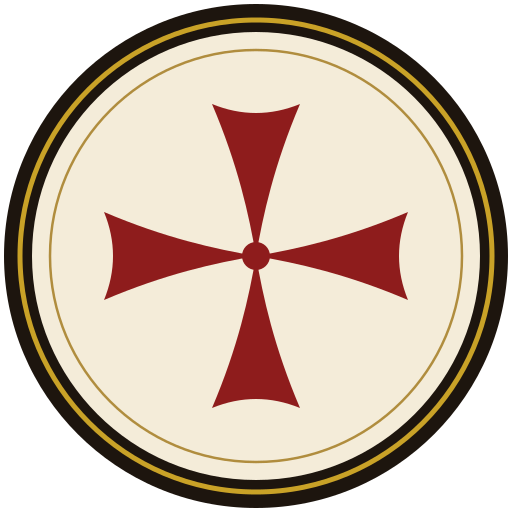
The Order of Christ used a distinctive cross that was based on the red cross of the Templars. The Order’s cross, sometimes called the Cross of the Order of Christ, was a red cross on a white background, similar to the Templar cross, but with a distinctive squared-off shape.
The Cross of the Order of Christ became one of the most important symbols of the Age of Discovery. The cross was painted on the sails of the Portuguese caravels, and it was carried by the Portuguese explorers on their voyages. The cross also features on the arms of Portugal and on the flag of the Order of Christ, which is still in use today.
For more on the symbolism of the Templar cross, see The Templar Cross and Mantle.
The Age of Discovery
The Order of Christ played a major role in the Portuguese Age of Discovery, the period from the early fifteenth to the early sixteenth centuries during which the Portuguese established a global maritime empire.
The most famous connection between the Order of Christ and the Age of Discovery is with Prince Henry the Navigator (1394–1460), a member of the Portuguese royal family who was a major patron of Portuguese exploration. Henry the Navigator was the Grand Master of the Order of Christ from 1420 until his death in 1460, and he used the Order’s resources to fund his voyages of exploration.
The Order of Christ also played a major role in financing the voyages of Vasco da Gama, who sailed around the Cape of Good Hope to India in 1497–1499, and of Pedro Álvares Cabral, who reached Brazil in 1500. The Order’s wealth and prestige made it a key player in the Portuguese maritime expansion.
The Order’s role in the Age of Discovery is also connected to one of the most famous symbols of the Portuguese Empire: the Cross of the Order of Christ, which was painted on the sails of the Portuguese caravels and which is still visible in many museums.
The Order in the Portuguese Empire
The Order of Christ continued to play a major role in the Portuguese Empire through the sixteenth and seventeenth centuries. The Order’s fortified churches in Brazil, in Africa, and in the Indian subcontinent are major pieces of European colonial architecture, and the Order’s missionaries were active in many of Portugal’s overseas possessions.
The Order’s overseas foundations included churches in the Azores, in Brazil, and in Portuguese India, as well as the Convent of Christ in Tomar, the Order’s principal headquarters. Many of these foundations are major pieces of Portuguese colonial architecture, and the Order’s missionaries were active in many of Portugal’s overseas possessions.
The Decline and Suppression
The Order of Christ began to decline in the seventeenth and eighteenth centuries, as the Portuguese Empire shrank and as the Order’s patronage waned. The Order was finally suppressed in 1834, as part of the liberal reforms of the Portuguese government during the Portuguese Civil War of 1828–1834.
The Order’s properties were confiscated by the Portuguese crown, and the Convent of Christ in Tomar became a state property. The Order’s archives were transferred to the Torre do Tombo, the Portuguese national archive, where they are still preserved.
The Order Today
The Order of Christ was officially extinct after 1834, but the title was revived in the twentieth century. The Order of Christ is now a decoration of the Portuguese Republic, awarded for service to Portugal in a variety of fields. The Order is also a major symbol of the Portuguese state, and the Cross of the Order of Christ appears on the coat of arms of the city of Tomar and in many other places in Portugal.
The Order’s history is also a major part of the modern Templar mythology. The Order of Christ is sometimes cited as evidence that the Knights Templar survived their suppression, and there are a number of neo-Templar organizations that claim descent from the Order of Christ. These claims are not supported by historical evidence, but they are a recurring element of the modern mythology.
From the primary source
“Cupientes itaque, ut … Ordo Militie Iesu Christi perpetuis futuris temporibus perseveret … quod omnes redditus, proventus, obventiones, possessiones et bona … que ad dilectos filios milites Templi Ierosolimitani in partibus Portugalie … dabimus et concedimus ea … dilectis filiis Magistro et fratribus Ordinis Militie Iesu Christi … Transferimus etiam … omnia bona … que nunc habent … in eisdem partibus regni Portugalie.”
(“Wishing therefore that … the Order of the Militia of Jesus Christ may endure for ever … we give and grant to … the Master and brethren of the Order of the Militia of Jesus Christ … all the rents, revenues, returns, possessions and goods which … belonged to the beloved sons, the knights of the Temple of Jerusalem in the parts of Portugal … We transfer also … all the goods … which they now have in those parts of the kingdom of Portugal.”)
— Pope John XXII, the bull Ad ea quae, 14 March 1319, trans. by the editorial team from the printed text in Augustin Coulon and S. Clemencet (eds), Lettres secrètes et curiales du pape Clément V et de Jean XXII se rapportant à la France (Bibliothèque des Écoles françaises d’Athènes et de Rome, 1903–1971), and the summary in Baigent, Leigh and Lincoln, The Holy Blood and the Holy Grail (Cape, 1982), app. II.
Sources & Further Reading
The standard modern work on the Order of Christ in Portugal is:
- Luís Adão da Fonseca, Os Templários em Portugal (QuidNovi, 2006) and A Ordem de Cristo e a Expansão Portuguesa (QuidNovi, 2010) — the principal modern Portuguese treatments.
- José Mattoso (ed.), História de Portugal, vol. 2 (Círculo de Leitores, 1992) — the standard modern Portuguese history.
- Baigent, Leigh and Lincoln, The Holy Blood and the Holy Grail (Cape, 1982) — contains an important appendix of the Order of Christ documents. Now regarded as untrustworthy on the modern mythology, but valuable for the primary-source transcriptions.
- Pedro Pinto, A Ordem de Cristo e a Conquista de Ceuta (Aula da Moeda, 2015) — the most recent specialist treatment of the Order’s role in the early Age of Discovery.
For the Order’s visual culture, see Vitor Serrão (ed.), O Convento de Cristo em Tomar (IPPAR, 2000), the official inventory of the Convent’s architecture and decoration.