What Is the Difference Between Templars and Teutonic Knights?
The Knights Templar and the Teutonic Knights (or Teutonic Order) were two of the great military religious orders of the medieval world. Although they shared many features — both were military religious orders, both wore distinctive mantles, and both were recognized by the papacy — they had very different origins, missions, and histories. The Templars fought in the Holy Land, while the Teutonic Knights waged a long campaign in the Baltic. The Templars were suppressed in 1312; the Teutonic Knights survived until 1525.
This article summarizes the key differences between the two Orders. It is a companion to The Military Orders of the Crusades and to Templars vs. Hospitallers.
Origins and Mission
The most fundamental difference between the two Orders lay in their origins and mission:
- The Templars were founded in Jerusalem in 1119 by the French knight Hugues de Payens, who formed a small brotherhood dedicated to protecting Christian pilgrims on the dangerous roads of the Holy Land. The Order was formally recognized at the Council of Troyes in 1129. For more, see The Founding of the Order.
- The Teutonic Knights (formally, the Order of Brothers of the German House of Saint Mary in Jerusalem) were founded in 1190 during the Siege of Acre as a hospital order for German crusaders. The Order was transformed into a military order in 1198 and redirected its mission to the Baltic in the 13th century.
The Templars were, from the start, a French-dominated order. The Teutonic Knights were, from the start, a German-dominated order.
Symbolism and Dress
The two Orders were distinguished by their symbols and dress:
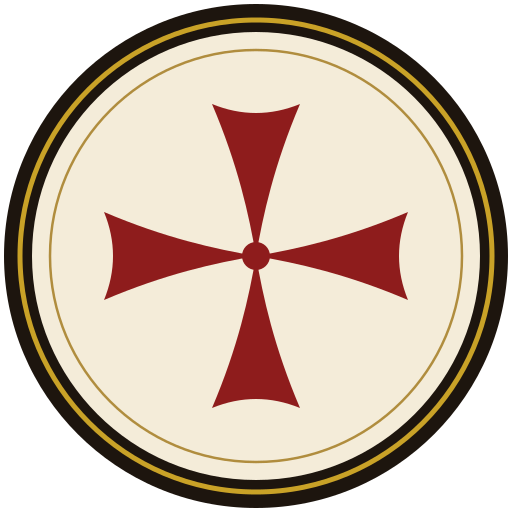
- The Templars wore a white mantle with a red cross. The symbolism of the cross. See The Templar Cross and Mantle.
- The Teutonic Knights wore a white mantle with a black cross. The black cross was a distinctive symbol of the Teutonic Order.
The two Orders’ mantles were similar in color (white), but the color of the cross was different: red for the Templars, black for the Teutonic Knights.
Geography
The two Orders had very different geographical focuses:
- The Templars were based in the Holy Land, with their principal headquarters on the Temple Mount in Jerusalem and, after 1191, in Acre. After the fall of Acre in 1291, the Order’s headquarters moved to Cyprus, and after 1312, the Order ceased to exist. The Templars’ story. See The Knights Templar in the Holy Land.
- The Teutonic Knights were based in the Baltic, with their principal headquarters at Marienburg (now Malbork in Poland). The Order established a monastic state that stretched along the Baltic coast, and it waged a long and brutal campaign against the pagan peoples of Prussia and Livonia.
The two Orders’ geographical separation meant that they had little direct contact with each other, and they developed very different military cultures.
The Reconquista and the Baltic
The two Orders also had very different relationships with the broader Crusading movement:
- The Templars were a major part of the Reconquista in the Iberian Peninsula, fighting against the Muslim states of al-Andalus. The Templars also had a major presence in the Crusader states of the Levant, where they were a key part of the Latin Christian presence.
- The Teutonic Knights were a major part of the Northern Crusades, the campaign to convert the pagan peoples of the Baltic to Christianity. The Teutonic Order’s campaign was brutal and controversial, and it was eventually defeated by a coalition of Poland and Lithuania at the Battle of Grunwald in 1410.
The two Orders’ very different military campaigns have led to very different modern reputations. The Templars are generally remembered as heroic warriors of the Crusades, while the Teutonic Knights are often remembered as brutal colonizers.
The Suppression
The two Orders had very different fates in the suppression of the military orders:
- The Templars were suppressed by Pope Clement V in 1312, and the last Grand Master, Jacques de Molay, was burned in 1314. The story. See The Trial and Suppression of the Knights Templar.
- The Teutonic Knights survived for two more centuries. The Order’s Prussian state was eventually defeated at the Battle of Grunwald in 1410, but the Order continued to exist in Livonia until 1561. The Order’s last Grand Master, Albert of Brandenburg, converted the Order’s Prussian state into a secular duchy in 1525.
The two Orders’ very different fates have given them very different legacies. The Templars are remembered for their dramatic fall, while the Teutonic Knights are remembered for their long and controversial campaign in the Baltic.
The Modern Legacy
The two Orders have had different modern legacies:
- The Templars are remembered as one of the great military religious orders, and they have given rise to a vast mythology. The modern legacy. See The Modern Legacy of the Knights Templar.
- The Teutonic Knights are remembered as one of the great military religious orders, but their legacy is more controversial. The Order’s Baltic campaign is sometimes criticized as a form of colonialism, and the Order is sometimes associated with the Nazi appropriation of the Order’s symbolism.
The story of the Teutonic Knights’ modern legacy is told in detail in other sources. The story of the Templars’ modern legacy. See The Modern Legacy of the Knights Templar.
Conclusion
The Knights Templar and the Teutonic Knights were two of the great military religious orders of the medieval world. Although they shared many features, they had distinct origins, missions, symbols, geographical focuses, and fates. The two Orders’ stories are different in many ways, but they are both important chapters in the history of the medieval Church and the medieval military orders. The story of the Templars. See The Knights Templar: A Complete History.